Wednesday, February 6, 2013

Gobatown!


2-5-13
     So we’re in Monrovia again, revisiting sites here that Nina and I visited in April of 2012. Lauren Wood, another nutrition consultant from GF&N, arrived this weekend and yesterday she, Nicole and I visited the Early Childhood Development center in Gobatown, about an hour outside of Monrovia. This is essentially a pre-school, a place for kids under five to receive education and an on-site meal. The kids here have been eating herring regularly for the past 9 months.
     Since our last visit, more of the kids have uniforms, and they have moved into a larger and newer building. They sang us a sweet welcome song, and then we went back to the outdoor kitchen to see the cooks preparing a large meal of herring stew and rice for the kids.
     Most Liberian food I’ve tried consists of a plate of rice with some sort of stew on top. The stew always has lots of spice from hot peppers (YUM), and a lot of oil. This stew had cassava greens, onion, peppers, herring, and oil. They brought the huge pot of stew and the huge pot of rice into the classroom and served the kids lunch, while mothers with little babies dined just outside the door. Nicole and Lauren chatted with moms and kids about how they liked the herring. Not surprisingly, people consistently said they liked it. 
     As usual, the kids were downright adorable. They gathered around Nicole and grabbed her hands, wiping them, almost like they were trying to wipe off her white skin and she would have brown skin underneath. Some kids were more afraid and suspicious than fascinated. A toddler started crying when I took his picture, which of course made me feel terrible because he was afraid of me, but his mom thought it was hilarious and kept telling me to take his picture. 

All in all a fun and successful visit!


 Someone had written this on the wall in the kitchen.


Lauren helps dish up lunch for the kids. 

 Loves the camera.


Sunday, February 3, 2013

Seeing the light


1-31-13
     Today (January 31, 2013), we went back to the VCT center for people living with HIV. Nicole offered
some refresher training for staff about accurately measuring the heights and weights of people receiving herring. She also provided people with valuable nutritional advice and tips on how to prepare and use the herring, and cook it with protective foods like greens and orange-fleshed squash. As people stopped by to pick up their medication, we chatted with them about their experience with the herring. I spoke with a man named Moses, who had 7 children. He said that since he’s been coming to the VCT, he gets counseling in addition to his medicine. Moses told me, “They say not to feel bad, that there is a solution. They say scientists are working on this. I see the light, since I am coming here.” The VCT is a place for people living with HIV to get emotional and spiritual support, critical medication, and now, extra healthy food. Moses and his family like the herring and he wants to continue to receive it. Again, highly nutritious fish like herring is hard to get in this upland area, and can be a great addition to people’s diets in the scarcity of other proteins. On top of that it has essential omega-3 fatty acids that are abundant in Alaskan herring and not available in local diets here.
     The reasons for food insecurity in Liberia are related to a general lack of infrastructure. The country went through a roughly 17-year period of instability, war, and violence during its civil wars, which ended in 2003. Hundreds of thousands of people were killed, and though the country is now peaceful, infrastructure is severely lacking and people are healing from an unspeakably dark and chaotic experience. There is no centralized electricity or plumbing system. There is deep and prevalent poverty. The unemployment rate is 80%. This really exacerbates health problems here like malaria, malnutrition, stunting, maternal mortality and tuberculosis, to name a few. It seems like even though it’s not ideal for a country to be receiving international aid and there are potential problems with it, Liberia lacks a lot of important resources, including widespread healthy food. I think everybody deserves healthy food, and this herring donation is a small step in a much greater transition toward self-sufficiency and food security for all.


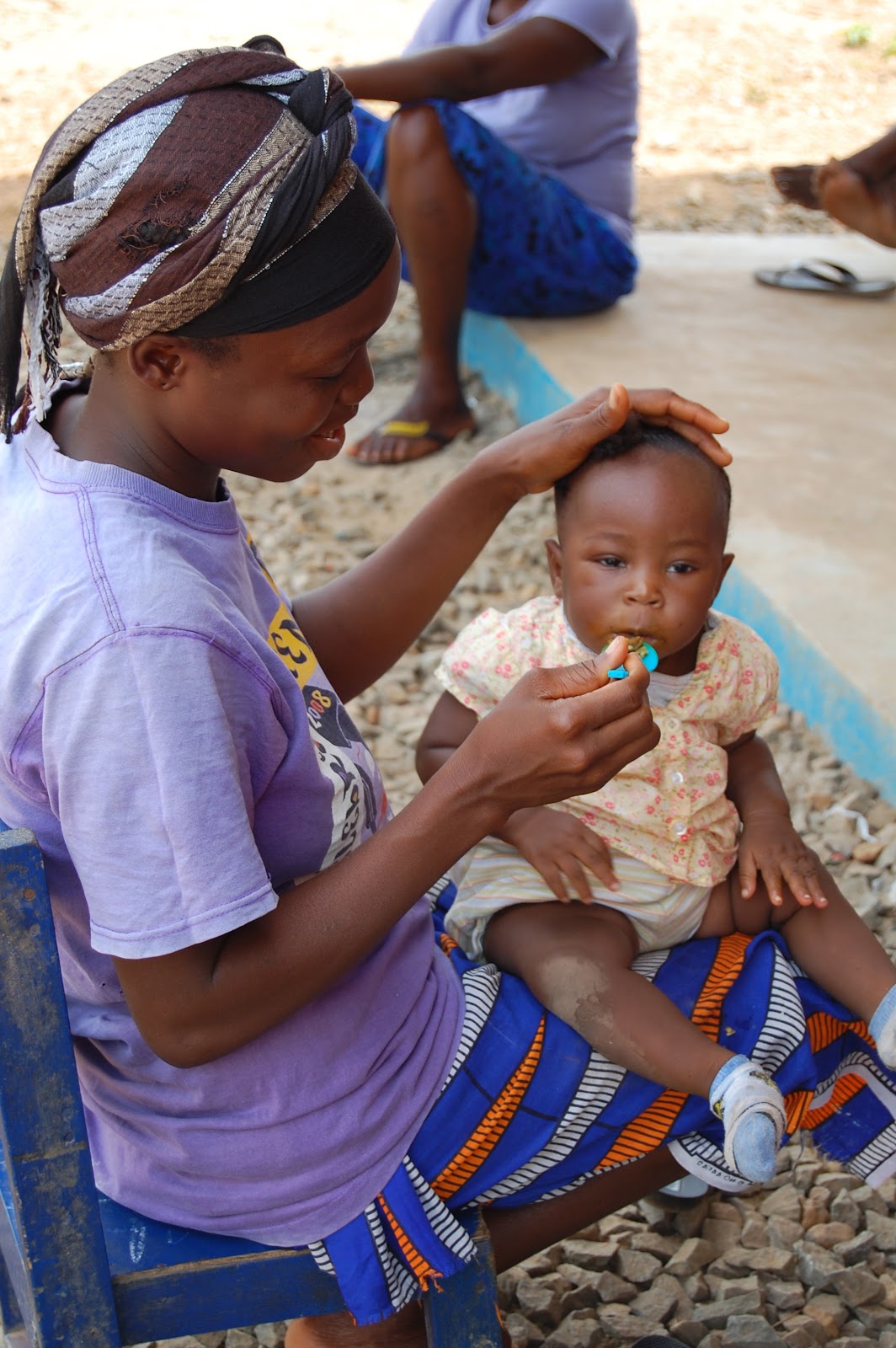
VCT patients and herring recipients. Breastfeeding in public is a non-issue here. Those are boxes of herring on the back shelf.


                                                                                  Talking with Moses


                                     Lapas= clothing, blankets, slings, diapers, bags...et cetera.


                                                                                     A coupla cuties.

“When women are in action…”


1-30-13
Yesterday Nicole and I visited several communities outside of Foya, tagging along with some SP directors who were checking on some projects. While we sat in on a savings and loans meeting in the town of Botemba, a director asked the local women in the meeting about how their savings and loans program worked. They sat with shy smiles on their faces, a bit afraid to answer. When a local man began to answer, a female director named Elizabeth hushed him and called out to the room. “When women are in action, great things happen!” The women started smiling and laughing. “When women are in action…” “...Great things happen!” They all answered her call in unison.
In Liberia men are usually heads of household and hold more power in general. Elizabeth had to coax the women to speak up about what they do. But, this is the first African country to have a female president, and lot of the development programs here aim to empower women through education, literacy, and business skills. Pretty cool!


Making palm oil in a community outside of Foya


Wednesday, January 30, 2013

A few more photos.


Nicole working with Karpie/Kimbaloe CLP staff member Josephine. People in this region speak Kissi rather than English as a first language, so Josephine helped translate for students as Nicole interviewed them. 1/28/13


                                        CLP students at Karpie/Kimbaloe with their fish. 1/28/13


Sweet shirt! At an aquaculture project outside Foya. Fresh fish is nearly impossible to get upcountry, but a few villages grow their own with support from SP. 1/30/13

Tuesday, January 29, 2013

Ten dollars can go a long way...

Today Nicole and I visited another CLP (night literacy class) in the village of Sardu, near Foya. We cruised up and down a bumpy dirt road, children waving and grinning madly at us as we passed them. Upon arrival, we met the students who have been receiving herring in the village’s church (Christianity is the dominant faith in Liberia).


 A laughing CLP student with her herring, and a little girl who doesn't know what to think of me.


We then went to SP’s VCT center, that’s Voluntary Counseling and Training. This program provides therapy, antiretroviral medication, and counseling for people living with HIV. It is the only place in this district of Liberia where people can get antiretroviral medicine.  People travel hours and hours each month to get a 30 day supply of the medicine they need to keep HIV restrained, and thus to survive. Some travel these long distances even though they don’t have the ten US dollars they need to pay for the month’s supply. Local health workers often help out – even though they don’t make very much themselves, they pay for the people’s treatment out of their own pockets, unwilling to let them walk away without being treated. I drop ten dollars on a couple of craft beers in Portland all the time...talk about perspective. I'd give those IPAs up in a heartbeat to pay for people's medication if I could.  Though we hear about inequalities like this all the time from a distance, it's far more grounding to experience it in real life. The importance of this program really can’t be overstated.

For the past nine months, people who have been coming to receive treatment also have been able to take home cans of Alaska herring. The herring’s nutritional benefits are especially vital for whose health and immune systems are compromised by the virus. As we chatted with about their experience with the herring, people consistently said they needed more herring. One man said he takes it back to his family, which includes nine children. The hospital administrator here told us that the herring really does make a difference, and he would like for those at the VCT to be able to continue to receive it if possible.  


         People at the VCT, including a woman wrapping up her herring for travel Liberian-style.

Liberia: Round 2!


Recap:

I’m Natalia Povelite, a second-generation commercial fisherman. I’m 24, originally from Kodiak, Alaska, and I like adventures.

I’m in Liberia again, assisting the Alaska Seafood Marketing Institute’s (ASMI) Alaska Global Food Aid Program (AGFAP), at the request of the ASMI AGFAP’s Director,  Bruce Schactler. The State of Alaska donated over 60,000 cans of herring to Samaritan’s Purse, an international aid organization, which distributed the herring to local people participating in their programs. Recipients tasted the herring for the first time 9 months ago, and have been receiving it ever since. I am here with Nicole Coglianese, a Nutritionist from ASMI AGFAP’s Washington DC based food aid & nutrition consulting group, Global Food & Nutrition, to see how this pilot project is going and to meet some of the people who have been eating the Alaska herring.

Foya, Liberia
January 28, 2013
Karpie and Kimbaloe CLP (Church-based Livelihoods Program)

Nicole and I arrived in Liberia last night and hopped on a Samaritan’s Purse (SP) helicopter this morning for a flight to SP’s base in Foya, a rural town in the northwestern corner of Liberia.
After watching the massive orange tropical sun rise to bring the daily heat (it's ninety-something degrees here), we glided over the green and lush countryside for over an hour, low enough to smell the smoke from people’s fires burning below us. The landscape changed from low and coastal to hilly and green, a sea of trees cut sometimes by red dirt roads, rivers, crops, and small houses.

Once in Foya, we drove a small distance to one of the sites of the herring donation, the Church-based Livelihoods Program (CLP). This program is essentially a night school for local people of the villages of Karpie and Kimbaloe (pronounced Kappy and Kimbaloo). Students, who are mostly women, learn to write their names and learn English. Monju, the program’s coordinator, explained that men are typically in the forefront of development, and though there are male students too, this program was intended to empower women specifically, as Liberia continues along its path of development. Liberia's illiteracy rate is 80 percent, so this program is incredibly empowering to these communities.

The recipients of the herring welcomed us graciously when we arrived, singing and clapping a
welcome song. Nicole spoke one-on-one with women who had received herring, while I observed and photographed Monju distributing the cans of fish to women.

Afterwards, people filled the classroom and we were warmly thanked by some of the herring recipients, as well as a local chief. ("I am the father of these people," he said.)

People were genuinely grateful and thankful for receiving the herring and many wished that we could provide more to them. As Monju explained to me, though fish is available on the coast, it goes bad by the time it reaches this area because there is no good way to preserve it. This herring is rich in high quality marine protein and Omega-3 fatty acids, and a welcome tasty addition to people’s diets. It was pretty incredible to see people in this remote and (to me) foreign corner of the world taking home cans of herring caught in cold Alaskan waters. In some ways, this place could not be more different from Alaska, yet people here are able to benefit from the wild fish caught there.


                                                              CLP students with their herring.


                                                 View from the chopper, just outside of Monrovia.

I’m more than excited to visit other program sites tomorrow and to see who else has been eating Alaskan fish over the last nine months!